Sustainable Ester Reduction by Aqueous SmI2/Amine: A Bimetallic Proton-Coupled Electron Transfer Mechanism from Density Functional Theory Calculations
Abstract
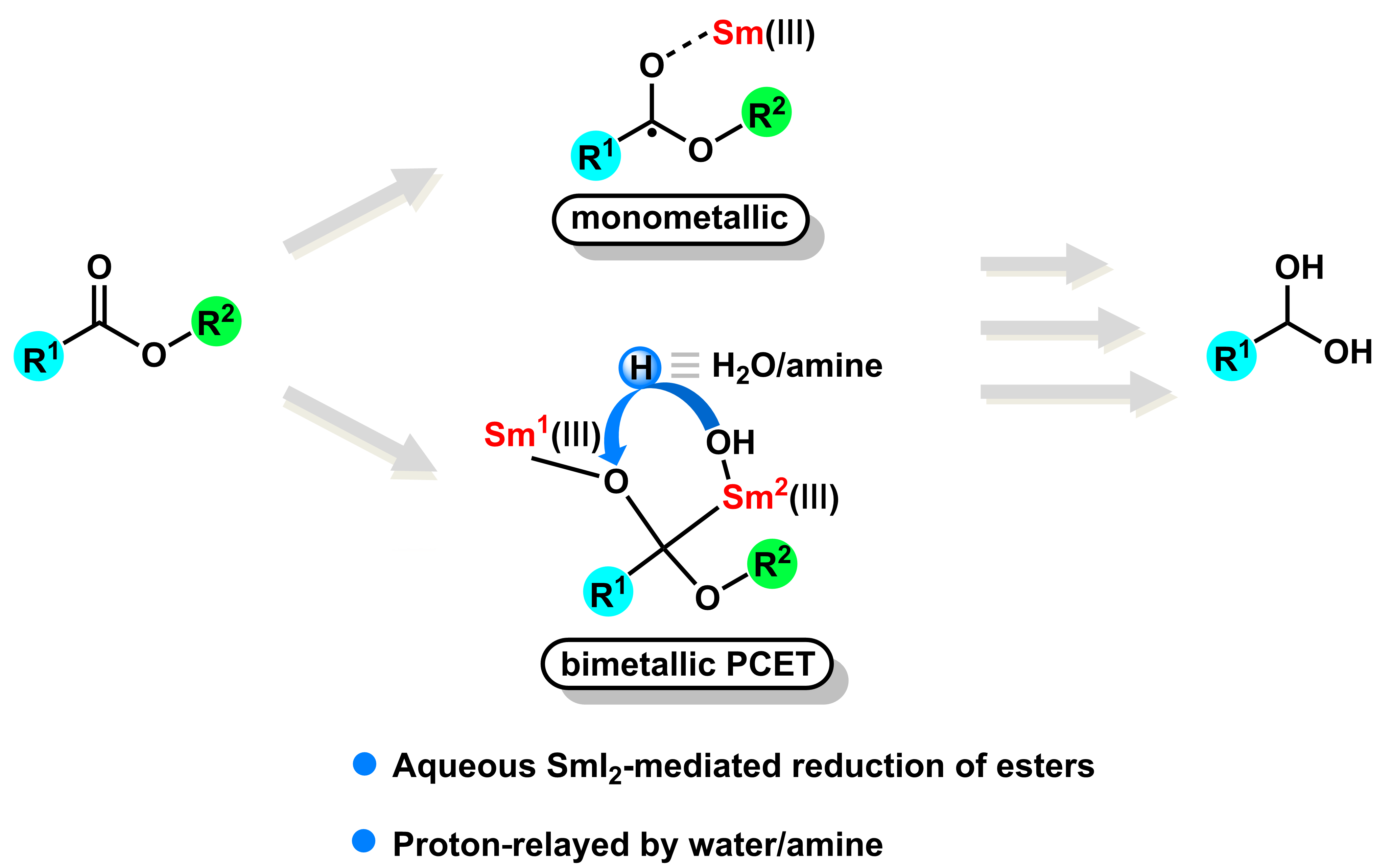
The mechanisms by which cyclic and acyclic aliphatic esters are reduced into their corresponding diols by SmI2 in water or water/amine solutions have been investigated computationally using density functional theory (DFT). Based on the calculations, the reduction is proposed to be initiated by a two-electron, two-metal reduction of the substrate, resulting in the formation of a bimetallic Sm(III)(substrate2−)Sm(III) complex. The reaction pathway then involves the protonation of the oxygen atom of the doubly reduced ketyl intermediate. For activated ester-lactone reduction, the lowest-energy pathway reveals the important role of a specific first-hydration-shell water molecule, which acts as the proton source and facilitates the overall transformation. For aliphatic esters in binary water/amine solution, the amine enables a proton cascade required to fulfill the reduction. As a consequence, the role played by the amine towards the reduction of aliphatic esters is attributed primarily to a specific relay in a proton cascade, in addition to, rather than instead of, any concurrent effect on the reduction potential of SmI2. The results establish a unified bimetallic proton-coupled electron transfer (PCET) mechanism for SmI₂-mediated ester reduction in aqueous and water/amine media, which may extend to other divalent lanthanides, broadening the range of aqueous-compatible single-electron reductants for green synthesis.
Graphical Abstract