Skeletal Editing of Polarized σ-Bonds via Formal Single-Carbon Insertion
Abstract
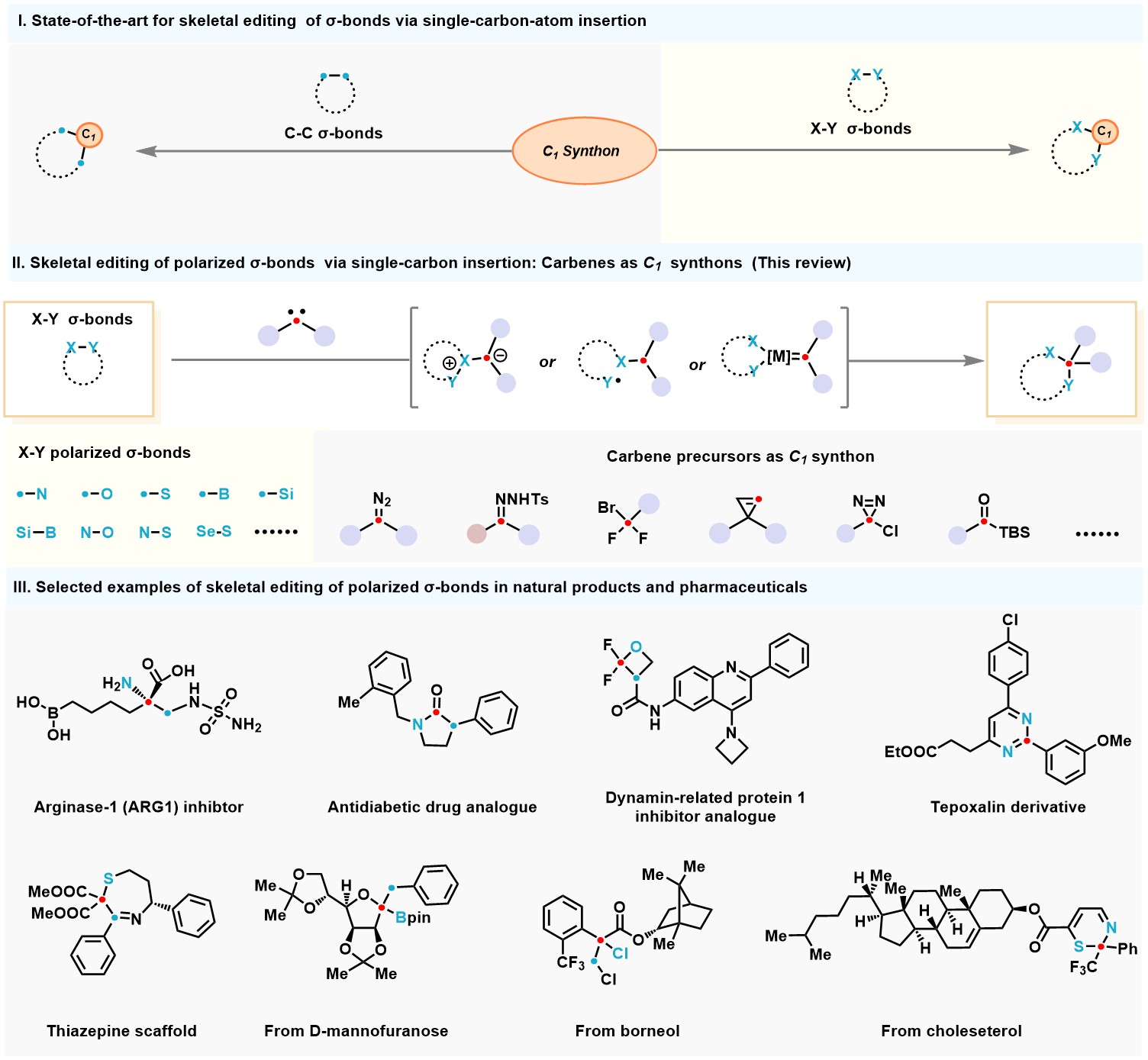
Carbenes represent a prominent class of single‑carbon synthons in organic synthesis, whose classic transformations have long focused on X‑H insertion, cyclopropanation, and ylide‑formation reactions. Enabled by advances in carbene‑precursor design, catalytic system development, and mechanistic investigations, carbene‑mediated formal single-carbon insertion has emerged as a powerful strategy for skeletal editing of organic molecules. By precisely inserting one carbon atom into pre‑existing polarized σ‑bonds, this approach enables ring expansion, skeletal reconstruction and carbon‑chain elongation, offering distinctive synthetic routes toward the efficient assembly of complex molecules and bioactive scaffolds. This review concentrates on recent advances in carbene‑mediated formal single-carbon insertion reactions. We systematically categorize these transformations by bond types, highlighting representative examples of carbene insertion into polarized σ-bonds including carbon‑heteroatom bonds (C–N, C–O, C–S, etc.) and heteroatom‑heteroatom bonds (N–O, N–S, etc.). Their reaction features and substrate scopes are discussed. Mechanistically, key reaction manifolds are summarized, including ylide formation, radical pathways, and migratory insertion of metal carbenes, illustrating the operating modes of diverse carbene systems in formal single-carbon insertion. Furthermore, sustainability considerations, including atom economy, catalyst loading, and greener activation modes, are highlighted, reflecting the growing demand for environmentally benign synthetic methods. Finally, current challenges and future opportunities in this rapidly evolving field are outlined, aiming to provide a useful guide for the rational design of novel single-carbon insertion reactions and their applications in medicinal chemistry and green pesticide discovery.
Graphical Abstract